#01Blade Inspection & Drones
Blade Inspection by Drone: Cracks, Erosion & Lightning Damage
Blade inspection by drone: autonomous or manual drone inspection of blades for cracks, erosion, lightning damage while in operation or stopped.
Items marked [Approval: Flag State / Class] depend on acceptance by flag states, classification societies, statutory authorities, customs, or inspection bodies today.
Acceptance is decided case by case by flag states, classification societies and authorities. ConnectPoint equips owners, operators, and surveyors with the cryptographic proof required whenever remote witnessing is submitted for validation.
Inspect turbine blades in motion or stopped, collaborate between harnessed rope-access climbers and onshore engineers, and preserve sealed logs for warranties and insurers.
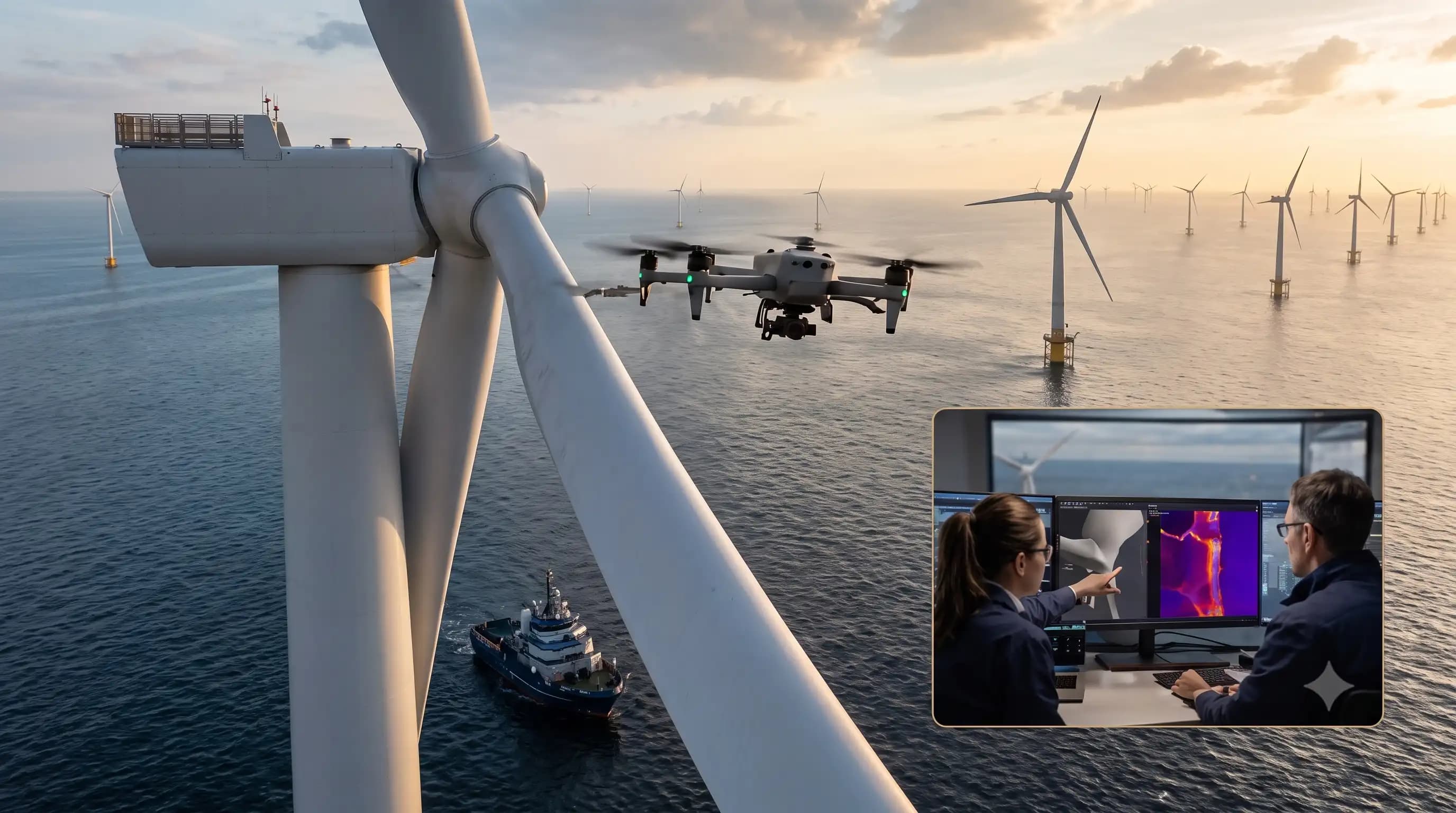
Blade inspection by drone: autonomous or manual drone inspection of blades for cracks, erosion, lightning damage while in operation or stopped.
Blade damage after storm or lightning: sealed video before repair begins to prove cause of damage for insurer and manufacturer.
Blade expert watches live: specialist ashore assesses damage in real time and decides whether turbine can continue operating or must be stopped.
Transport and installation: condition at quay before loading, on installation vessel, after erection on tower documented in sealed chain.
Commissioning and takeover from supplier: complete baseline recording before warranty begins; dispute prevention between operator and OEM.
Warranty: documenting all defects before end of warranty (End of Warranty inspection) with sealed log to substantiate claims against supplier.
Foundation and transition piece: monopile, jacket, gravity base, floating foundation; splash zone and subsea inspection via ROV/AUV/USV.
Cables and CPS (Cable Protection Systems): array cables, export cables, touch-down point, scouring around cable documented.
Bolts, flanges and tower: inspection of bolted connections (torque check), flanges, paint damage, corrosion internal and external.
Nacelle, gearbox and generator: technician in nacelle connects specialist ashore; live video, vibration and sound recorded in sealed log.
Damage from vessels: CTV (Crew Transfer Vessel) or SOV colliding with wind turbine; dispute between operator, vessel owner and insurer.
HSE: work at height, rope access, evacuation and rescue routes; condition documented before and after work.
Insurance: before/after recordings for claims, pre-season baseline recording (before storm season) to substantiate damage.
Certification and class inspections carried out remotely.
Status note: Dependent on class society and certification body guidelines.
Regulatory and environmental supervision: documentation of bird, bat, marine mammal protection, underwater noise measurements during piling.
Status note: May be considered by authorities case by case. Not accepted today.
Beacons and fixed sensors on blades and tower: continuous condition monitoring instead of periodic inspection.
Status note: Credit against scheduled service depends on turbine OEM and wind farm operator agreement.
Decommissioning and repowering: documenting condition of old turbines, removal process, recycling of blades and materials.
Port phase: inspection of blades, tower sections and nacelles on quay before loading onto installation vessel.
ConnectPoint is software. It runs on standard equipment from Samsung, DJI and Starlink. The only hardware we make ourselves is the mobile Wi-Fi point for tanks and holds. Use cases below show how sealed records support remote inspection across maritime, offshore, ports and wind.